A labor unit is the number of labor hours one unit of work takes: hours per fixture, per foot of conduit, or per hundred feet of wire. Multiply it by the quantity and you have hours; multiply the hours by your labor rate and you have labor cost. Labor is where your own crews and conditions show up in a lighting estimate, so it is the part a price list cannot fill in for you.
This guide does not give you numbers, on purpose. Labor units vary with the crew, the building, the ceiling, the access and what the unit is meant to include. What it gives you is a way to build units you can defend, using the fixture types from one real lighting plan sheet of a public bid set as the example.
Start with what a unit includes
Two estimators can use the same number and mean different work. Write down, for each unit, what is inside it. A fixture unit usually covers some of:
- Receiving, handling and moving the fixture to where it goes.
- Layout and marking.
- Supports: hangers, independent support wires, strut, or the structure attachment the specification asks for.
- Mounting and assembly (pendant stems, joining linear sections).
- Making the connection to the branch circuit.
- Testing, aiming and cleanup.
Then list what is outside it, so it is priced elsewhere: branch conduit and wire, home runs, switches and sensors, lifts and equipment. A clear list stops the same work from landing in two units, or in none.
Give each kind of fixture its own unit
One "light fixture" unit hides big differences. Split units by the things that change the work: mounting, size, weight, height and whether the fixture is sold by length. Here is how the fixture types on our example sheet fall into groups, with the count of each type on that one sheet from our run:
| Kind of work | Types on the example sheet (count) |
|---|---|
| Troffers and flat panels in a grid | A 72, A2 9, B 59, K 32 (lay-in); X 65 (2' x 2', recessed) |
| Recessed in drywall | N 1 (2' x 4' flanged for drywall) |
| Downlights | L 42, S8 18, Z 5, C 2, O 3 (shower) |
| Surface, chain and high bay | G 41 (4' industrial), H 35 (high bay), D 1 |
| Pendants | Q 19 (4" cylinder), V1 6 (8' by 4' square pendant) |
| Linear suspended, by length | M 4 (4'), M1 6 (8'), M2 1 (12') |
| Exterior wall | S7 15 (wall pack) |
| Exit signs and controls | 31 exit signs and 69 controls, each with their own units |
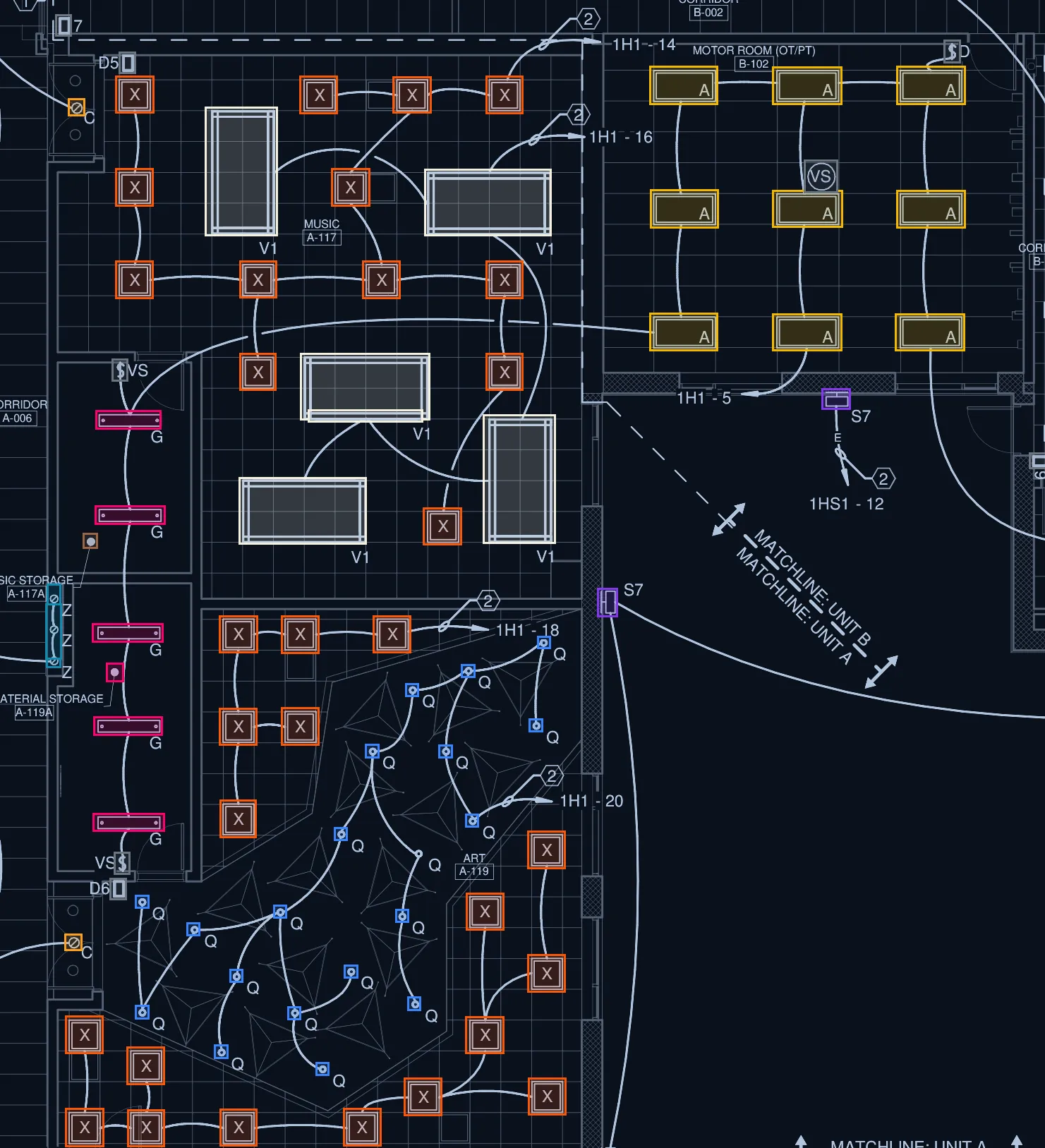
The 8' by 4' square pendant and the 4" pendant cylinder are both "pendants", but they are not the same job. Where a single type is large, heavy or unusual, give it its own unit or a multiplier on the group unit.
Know what changes the hours
The same fixture takes different time on different jobs. Keep a short list of conditions and decide, per job or per area, whether each one applies:
- Height. Work from a ladder, a lift or a scaffold changes the pace. A gym with high bays is not a classroom with troffers.
- Ceiling type. Lay-in grid, drywall, open to structure. The example set's fixture notes require pendants in open ceiling areas to be "suspended from the structure", with strut support where needed, which is more work per pendant than hanging from a grid.
- Access and site. Occupied buildings, phased work, night shifts, security, long carries.
- Repetition. Fifty identical classrooms go faster per fixture than five different ones.
- Exterior work. Weather, poles and bases, and equipment.
Apply conditions as multipliers on a clean base unit, not by editing the base unit for every job. That keeps your base comparable from bid to bid.
Use published references as a starting point
Published labor references exist. NECA's Manual of Labor Units, now in a 2025-2027 edition, is described as reference data for estimating the labor required for common electrical and communications installation work [1]. A reference like that is a reasonable place to start a unit you have no history for. It cannot know your crews, your buildings or how you define the unit, so treat it as the opening value, not the answer.
Build units from your own jobs
The units you can trust are the ones your own jobs produced. To build them:
- Track hours by kind of work. Set up cost codes that match your unit groups (troffers, downlights, pendants, high bays, exit signs, controls, conduit, wire) and have hours charged to them.
- Record installed quantities for the same groups, from the takeoff and from change orders.
- Divide. Hours charged to a group over the quantity installed is that job's actual unit.
- Note the conditions of each job (height, ceiling, occupied or not), so you compare like with like.
- Compare across jobs and update your base units after each one. Ask the foreman where the job ran long, and why.
For the example sheet, the arithmetic is simple once the units are yours: type A is 72 lay-in troffers, so its fixture labor is 72 times your troffer unit, times any condition multiplier. None of this works unless the quantities are right, which is why the count by type opens the order of work.
How InstantTakeoff handles labor
In InstantTakeoff you keep labor units in hours per fixture or per foot for each kind of work: troffers, downlights, surface, pendants, wall mounts, high bays, exterior, emergency units, exit signs, switches, sensors, conduit and wire. Starting values are marked "Starting point" until you set your own. Each fixture type picks its unit from the fixture schedule's description and mounting, and you can change it per project. Labor rates are yours too: one default, plus named rates such as a foreman rate on any unit. The estimate then shows quantity, hours and labor cost for every line, next to material.
Get the quantities your labor units multiply: try a sheet free. No signup, no card. Already price in another estimating tool? Excel, CSV, the API and the MCP connector work today, and if you need a direct connection, ask us and we'll build it, often the same day.
Sources
- Construction Owners, "NECA Releases 2025-2027 Manual of Labor Units" (September 23, 2026): constructionowners.com (checked 2026-11-13)
Questions
Is there a standard labor unit for a 2x4 troffer?
There are published references, such as NECA's Manual of Labor Units, but no single number fits every job. Ceiling height, ceiling type, access, crew, building type and what your unit includes all change the hours. Use a reference as a starting point and adjust it with your own job records.
Should the fixture labor unit include the whip and the connection?
That is your choice, as long as it is consistent. One clean approach is to keep the fixture unit to mounting and connecting, and price branch conduit, wire and whips as their own lines. What matters is that no item is in two units and no item is in none.
Per fixture or per foot for linear lighting?
Long linear runs are easier to price per foot plus a unit for each end, joint or suspension point; short linear fixtures are fine per fixture. On the example schedule, linear suspended types run from 4' to 32', which is why one unit per fixture would not fit them all.
What labor units does InstantTakeoff use?
Yours. Each kind of work (troffers, downlights, surface, pendants, wall mounts, high bays, exterior, emergency units, exit signs, switches, sensors, conduit and wire) has a labor unit in hours per fixture or per foot. Starting values are marked "Starting point" until you set your own.